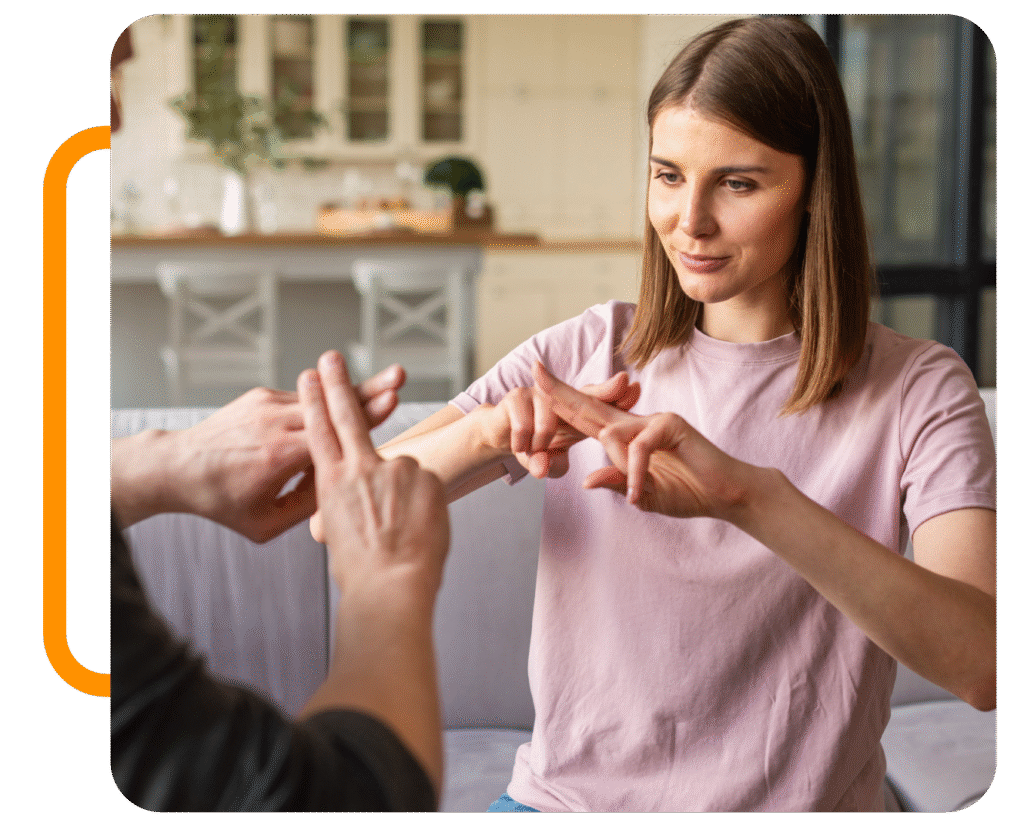
Connecting Communities Through Deaf Culture Awareness
You’re in a brightly-lit, open-space community center. There are areas where Deaf people share their hobbies, interests, talents, skills, and knowledge with Deaf and hearing audiences.There are spaces for performances, collaborative art projects, classes, and exhibitions.
There are spaces where Deaf people can both access and provide skilled services in their language. The collective efforts of this organization have created a city-community where Deaf needs are met, and where hearing people appreciate Deaf language and culture.
Why SignBridge?
SignBridge grew from a simple observation: people who needed one another did not always have an easy way to connect.
Parents of Deaf and hard-of-hearing children often want to learn sign language but struggle to find affordable, accessible instruction that fits into family life. Many are also looking for something a traditional language class cannot provide: relationships with Deaf adults who can help them understand their child’s experiences and offer a glimpse of what their child’s future might hold.
Early access to a complete and accessible language is critical. When children do not have consistent access to language during the years when their brains are developing most rapidly, the effects can extend far beyond communication. Language deprivation can affect learning, relationships, emotional development, and a child’s ability to participate fully in the world around them.
At the same time, Deaf adults already possess the language, lived experience, and cultural knowledge these families are seeking. Many also face limited opportunities to use those abilities in work that is meaningful, valued, and fairly compensated.
The solution seemed remarkably simple: connect the people who needed language and guidance with the people who already had the knowledge and experience to provide it.
Thus, SignBridge’s original goal was to develop a family language program built around relationships with Deaf adults, supported by expertise in language development, and designed to help families create accessible communication at home.
As the idea developed, similar gaps became visible elsewhere. Deaf artists and creators were looking for audiences and opportunities to share their work. Businesses wanted to improve accessibility but needed guidance from people with lived experience. These became additional branches of SignBridge—valuable in their own right, while also helping create the relationships, opportunities, and financial support needed to sustain the family language program at the organization’s center.
There was another need as well: a space for people who did not always feel fully at home in either the hearing world or the Deaf world.
Late-deafened adults, hard-of-hearing people, oral or non-signing Deaf people, partners and family members of Deaf people, ASL learners, and others often described feeling caught between communities. Some felt they were not “Deaf enough” for one space or fully understood in another. Many believed they were alone in that experience.
SignBridge was created to be their space, too—a place where people could belong without having to prove that they met someone else’s definition of Deafness, hearing, language, or identity.
At first glance, family language support, Deaf arts and culture, business accessibility, and community-building may seem like unrelated areas of work. But the same three ideas run through all of them:
Connection. Communication. Community.
Connecting families with Deaf mentors. Connecting creators with audiences. Connecting businesses with Deaf expertise. Strengthening communication within families, workplaces, and the broader community. Building spaces where people can learn from one another, contribute their strengths, and feel that they belong.
Those are the throughlines that became SignBridge.
Our Mission
To build bridges and close the gap between the deaf and hearing worlds through initiatives to promote language access, foster understanding and appreciation of Deaf culture, and advocate for inclusion and accessibility.

Our Vision
A community where those at the intersection between Deaf and hearing cultures can be valued and celebrated, and where inclusion and accessible communication are prioritized to allow connections to form and relationships to flourish between hearing and D/deaf individuals.
Our Vision
A community where those at the intersection between Deaf and hearing cultures can be valued and celebrated, and where inclusion and accessible communication are prioritized to allow connections to form and relationships to flourish between hearing and D/deaf individuals.
Our Mission
To build bridges and close the gap between the deaf and hearing worlds through initiatives to promote language access, foster understanding and appreciation of Deaf culture, and advocate for inclusion and accessibility.
About SignBridge
This organization connects Deaf and hearing communities through:
Combating Language Deprivation: Providing sign language instruction to Deaf children and their families, provided by fluent Deaf sign-language users (with support from trained educators when needed), thereby reducing language deprivation.
Workshops and classes: Providing a platform through which Deaf adults will be paid to share their skills and interests with Deaf and hearing audiences/learners by leading workshops, teaching classes, and representing the Deaf community in local festivals and other events.
Consulting Services: Providing Deaf consulting services for businesses who would like to learn how to be more accommodating to their Deaf employees, customers, clients, and/or patrons, making the community vastly more Deaf-friendly.
Deaf perspectives and Deaf needs are prioritized within the objectives of the organization. If you are interested in getting involved, please fill out the form here. Please also share the link to other people who might be interested.
Why Another Organization?
St. Louis already has Deaf-led organizations doing important work in language access, education, culture, advocacy, and community support. SignBridge shares many of those concerns because we are responding to some of the same persistent needs.
Our approach begins from a particular position: the space between communities.
SignBridge brings together Deaf and hearing people, families, creators, professionals, businesses, ASL learners, and people who do not always feel fully at home in either Deaf or hearing spaces. We create entry points for people to build relationships, learn from one another, and contribute to the community from wherever they are beginning.
Our family language initiative brings together expertise in language development with the language, cultural knowledge, and lived experience of Deaf adults. Our arts programming seeks to create opportunities and audiences for Deaf creators. Our accessibility work connects organizations and businesses directly with Deaf expertise. Our broader community gives hearing people and other allies meaningful ways to support Deaf leadership and carry greater awareness into their own families, workplaces, and neighborhoods.
We see this work as complementary to what other organizations are already doing. A stronger and more connected community creates more opportunities for everyone.
Our goal is to help more worthwhile projects get off the ground.
The Founder’s Role
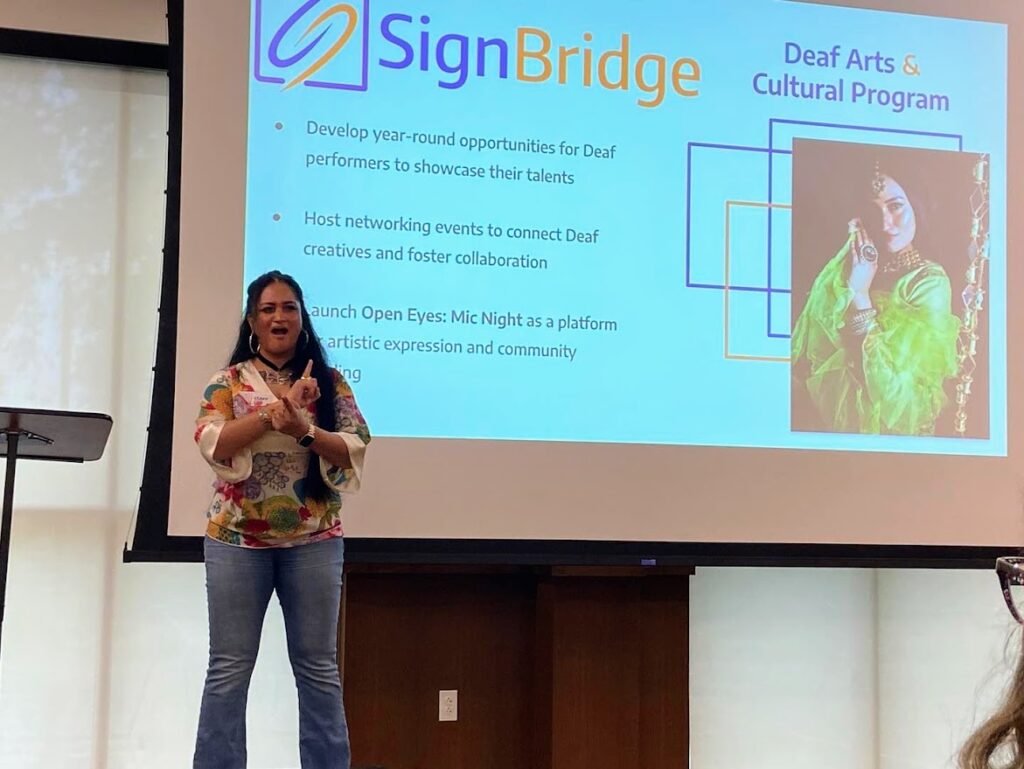
SignBridge was founded by Rebecca Davis, a hearing speech-language pathologist with nearly twenty years of experience in language development and family support.
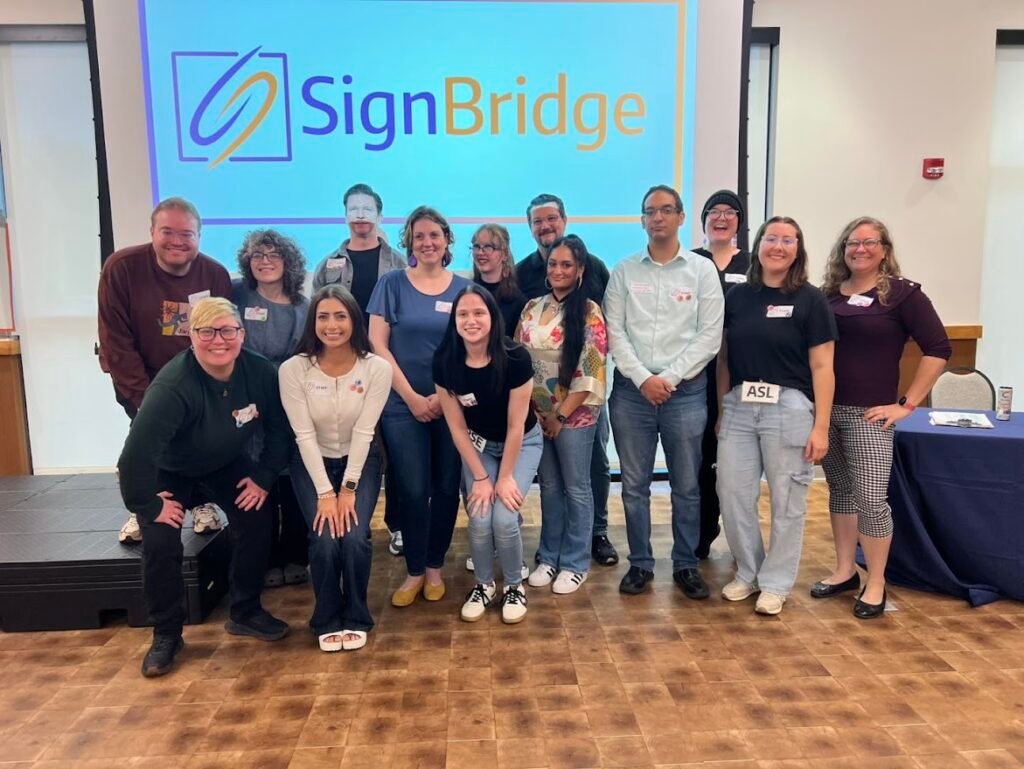
In 2017, Rebecca founded the STL ASL Meetup Group to create more opportunities for people to use sign language and build relationships. She continued organizing and leading the group for nine years as it grew to more than 1,200 members. Through that work, she developed relationships with Deaf and hard-of-hearing community members, interpreters, ASL students, families, educators, and others interested in language and communication access.
Her appreciation for the critical importance of early language access guided her to work with families of Deaf and hard-of-hearing children. There, she saw how urgently many parents wanted accessible language for their children and how difficult it could be to find the right support. Her professional expertise in language development also helped her understand the kind of structure families would need to make sign language part of everyday life.
To ensure that her own ASL skills and cultural understanding were strong enough for her to serve as a responsible resource to parents, Rebecca pursued an associate degree through an accredited interpreter training program.
Throughout these experiences, she gradually took on the role of noticer and connector: recognizing where needs and resources aligned, bringing the right people into the room, and helping ideas move from possibility to action. She carried that role into SignBridge through a facilitative, collaborative approach to leadership—creating structure, opening doors, and making space for others to contribute their knowledge and take the lead.
That role also has clear limits. Expertise in language development does not replace Deaf lived experience. SignBridge’s programs are strongest when Deaf people are present from the beginning to shape the work, lead within the organization, and bring their knowledge directly to families, businesses, audiences, and the wider community.
How We Work
SignBridge is built around collaborative leadership. Deaf people serve in leadership roles, design and lead programs, share their expertise, and help determine how the organization grows.
We believe Deaf knowledge and labor should be recognized and compensated. We also believe community input should influence the work from the beginning—not only after plans have already been made.
We want people to tell us what the community needs, what we are getting right, and where we need to change. Trust is earned through our choices: whom we listen to, how we respond to criticism, how resources are distributed, and whether our work creates meaningful opportunities.
SignBridge will continue learning, building relationships, and adjusting its work in response to the people it exists to serve.
Our purpose is to bring the right people into the room together—and help turn connection into action.
Social Media Introduction
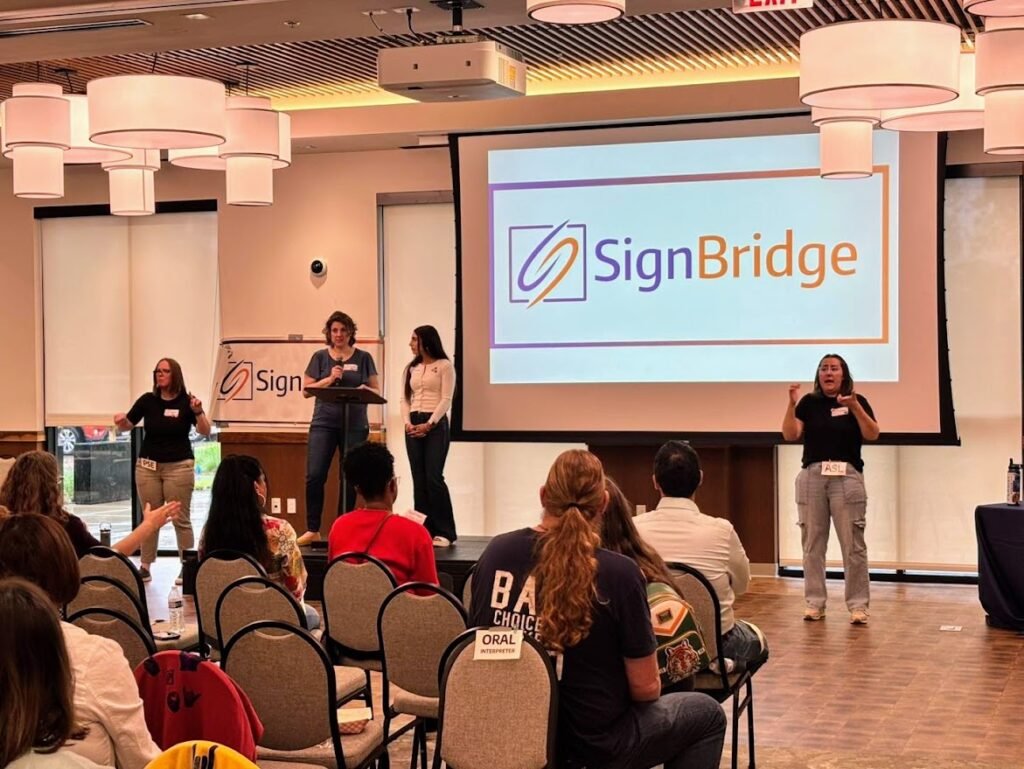
You may know SignBridge from our community events—but those events are only the most visible part of why we exist.
Over the past year, our public face may have looked a lot like that of a social organization. Community-building was some of the first work we were able to put into motion, while our family language program and other long-term initiatives have taken more time to develop.
But bringing people together was never separate from our larger purpose. It is the foundation of it.
SignBridge began with a vision of connecting families of Deaf and hard-of-hearing children with language, guidance, and Deaf adult role models. That vision grew to include opportunities for Deaf creators, accessibility partnerships with businesses, and a welcoming space for people who do not always feel fully at home in either Deaf or hearing communities.
These areas may seem unrelated at first, but the same three ideas connect them:
Connection. Communication. Community.
Goal 1:
Promote Accessibility of Sign Language and Combat Language Deprivation
-
Objective 1.1
Provide sign language instructional support by Deaf instructors to D/HH children and their families.
-
Objective 1.2
Offer sign language classes taught by Deaf instructors to diverse audiences including neurodivergent people, laryngectomees, and other interested community members.
-
Objective 1.3
Provide accessible educational, creative, and cultural learning opportunities for Deaf children and adults.
Goal 3:
Ensure Sustainability and Growth
-
Objective 3.1
Develop a diversified funding strategy including grants, donations, fees for consultation services, and revenue from a future café or other enterprise.
-
Objective 3.2
Build a strong volunteer and donor base through effective outreach, engagement, and recognition programs.
-
Objective 3.3
Establish robust financial management practices and operational efficiencies to ensure long-term sustainability.
Goal 2:
Foster Community Engagement and Cultural Understanding
-
Objective 2.1
Host cultural events, workshops, and exhibitions that showcase Deaf talents and contributions, and educate hearing people on Deaf etiquette such as how to correctly interact with a Deaf person through an interpreter.
-
Objective 2.2
Provide consulting services to local businesses on creating Deaf-friendly environments and ADA compliance.
-
Objective 2.3
Establish a community center as a hub for social gatherings, educational sessions, and skill-sharing activities.
-
Objective 2.4
Develop online resources and virtual programs (e.g., ASL learning videos, virtual workshops) to reach broader audiences and overcome physical barriers.
-
Objective 2.5
Partner with local organizations (e.g., DEAF Inc., MCDHH) to maximize impact and resources for the Deaf community.
Goal 1:
Promote Accessibility of Sign Language and Combat Language Deprivation
-
Objective 1.1
Provide sign language instructional support by Deaf instructors to D/HH children and their families.
-
Objective 1.2
Offer sign language classes taught by Deaf instructors to diverse audiences including neurodivergent people, laryngectomees, and other interested community members.
-
Objective 1.3
Provide accessible educational, creative, and cultural learning opportunities for Deaf children and adults.
Goal 2:
Foster Community Engagement and Cultural Understanding
-
Objective 2.1
Host cultural events, workshops, and exhibitions that showcase Deaf talents and contributions, and educate hearing people on Deaf etiquette such as how to correctly interact with a Deaf person through an interpreter.
-
Objective 2.2
Provide consulting services to local businesses on creating Deaf-friendly environments and ADA compliance.
-
Objective 2.3
Establish a community center as a hub for social gatherings, educational sessions, and skill-sharing activities.
-
Objective 2.4
Develop online resources and virtual programs (e.g., ASL learning videos, virtual workshops) to reach broader audiences and overcome physical barriers.
-
Objective 2.5
Partner with local organizations (e.g., DEAF Inc., MCDHH) to maximize impact and resources for the Deaf community.
Goal 3:
Ensure Sustainability and Growth
-
Objective 3.1
Develop a diversified funding strategy including grants, donations, fees for consultation services, and revenue from a future café or other enterprise.
-
Objective 3.2
Build a strong volunteer and donor base through effective outreach, engagement, and recognition programs.
-
Objective 3.3
Establish robust financial management practices and operational efficiencies to ensure long-term sustainability.

Phase 1: Building the Foundation
- Complete incorporation and obtain 501(c)(3) status.
- Recruit and onboard board members and key staff.
- Develop and launch initial cultural workshops.
- Launch outreach efforts to increase participation and community support.
- Explore funding avenues and build financial strategy.

Phase 3: Establish partnerships with local businesses for consulting services
- Continue to evaluate program effectiveness and impact; adjust strategies as needed.
- Implement virtual programs and resources to enhance accessibility.
- Explore opportunities for growth, such as additional community partnerships.
- Set up deaf job fairs and employment opportunities.

Phase 5: Expand and Replicate in other Cities and States

Phase 2: Sustainability and Expansion
- Evaluate program effectiveness and impact; adjust strategies as needed.
- Develop and launch initial sign language classes and mentorship program.
- Launch additional educational and recreational programs.
- Collaborate with other local organizations to extend reach.

Phase 4: Community Center Development
- Continue to evaluate program effectiveness and impact; adjust strategies as needed.
- Secure funding and locate a suitable space for the community center.
- Expand programs and services to include accessible critical resources provided by and/or for Deaf individuals. May include:
- Social Work
- Addiction recovery services
- Employment Services
- Financial Services
- Legal Services
- Educational Advocacy
- Medical Advocacy
- Transportation Services
- Parenting classes
- Criminal Justice Advocacy

Phase 1: Building the Foundation
- Complete incorporation and obtain 501(c)(3) status.
- Recruit and onboard board members and key staff.
- Develop and launch initial cultural workshops.
- Launch outreach efforts to increase participation and community support.
- Explore funding avenues and build financial strategy.
Phase 2: Sustainability and Expansion
- Evaluate program effectiveness and impact; adjust strategies as needed.
- Develop and launch initial sign language classes and mentorship program.
- Launch additional educational and recreational programs.
- Collaborate with other local organizations to extend reach.
Phase 3: Establish partnerships with local businesses for consulting services
- Continue to evaluate program effectiveness and impact; adjust strategies as needed.
- Implement virtual programs and resources to enhance accessibility.
- Explore opportunities for growth, such as additional community partnerships.
- Set up deaf job fairs and employment opportunities.
Phase 4: Community Center Development
- Continue to evaluate program effectiveness and impact; adjust strategies as needed.
- Secure funding and locate a suitable space for the community center.
- Expand programs and services to include accessible critical resources provided by and/or for Deaf individuals. May include:
- Social Work
- Addiction recovery services
- Employment Services
- Financial Services
- Legal Services
- Educational Advocacy
- Medical Advocacy
- Transportation Services
- Parenting classes
- Criminal Justice Advocacy